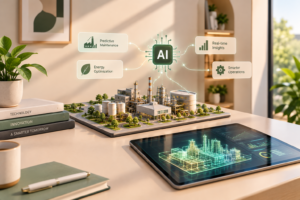
Artificial Intelligence in Business: From Experimentation to Strategic Execution
An overview of how businesses are using AI technologies—including machine learning, natural language processing, generative AI, predictive analytics, and computer vision—to automate work, improve decision-making, and drive value, along with the key challenges and implementation steps.

Defining AI in Business
Artificial intelligence in business refers to the use of AI technologies—such as machine learning (ML), natural language processing (NLP), generative AI, predictive analytics, and computer vision—to automate work, optimize operations, improve decision-making, and generate business value. Early applications often centered on pilot projects or simple task automation. As the technology matures and adoption widens, organizations now leverage AI to analyze structured and unstructured data, enhance customer experiences, streamline workflows, strengthen cybersecurity, support content creation, modernize applications, improve forecasting, and aid real-time decision-making.
The overarching goal is to help companies move faster, reduce manual effort, and uncover actionable insights that traditional data analysis alone might miss. However, successful AI deployment requires more than adopting standalone apps or chatbots. Businesses need a solid data foundation, an effective governance model, a plan for employee skills development, and alignment of AI capabilities with specific business needs and expected returns.
Key AI Technologies in Business
Machine learning uses algorithms to identify patterns in data and generate predictions or classifications. In business, ML supports demand forecasting, fraud detection, pricing optimization, customer segmentation, churn prediction, and risk scoring. For example, a retailer might analyze customer data, e-commerce behavior, inventory levels, and seasonal buying patterns to predict regional product demand. A financial institution might use ML to flag suspicious transactions in near real time.
Natural language processing enables computers to understand, interpret, and generate text or speech. NLP powers chatbots, virtual assistants, document summarization, sentiment analysis, search, translation, and knowledge management. In customer support, it can classify service requests, summarize interactions, and recommend next-best actions. In marketing, NLP analyzes social media conversations, product reviews, and call transcripts to identify emerging customer needs.
Generative AI creates new content—text, code, images, summaries, product descriptions, reports, emails, and software tests—based on prompts and context. Businesses use generative AI for content creation, market research, software development, knowledge discovery, and employee productivity. Unlike earlier AI tools that primarily classified or predicted, generative AI produces drafts, ideas, and recommendations. However, outputs require human review, validation, and governance, especially in regulated industries where accuracy, privacy, security, intellectual property, bias, and compliance must be considered.
Predictive analytics uses historical and current data to estimate likely future outcomes. Together with data analytics (which explains what already happened), predictive analytics supports forecasting, capacity planning, supply chain optimization, customer engagement, and financial planning. A manufacturer might anticipate equipment failures; a small business might estimate cash flow based on sales trends.
Computer vision enables AI systems to interpret images and video. It is used in healthcare imaging, manufacturing quality control, retail shelf monitoring, insurance claims processing, logistics, and workplace safety.
Current Adoption and Strategic Shift
According to IBM Institute for Business Value (IBV) research, 79% of executives say AI has improved productivity and will contribute significantly to revenue by 2030, but only 24% can clearly see from where that revenue will come. This gap highlights a defining challenge: companies see productivity benefits but struggle to connect AI use to financial outcomes and long-term competitive advantage.
Research also indicates that 93% of executives say AI sovereignty must be factored into their 2026 business strategy, while 53% expect AI to transform business models in their industry by 2030. They anticipate AI will increase productivity by 42% by 2030, with 67% expecting most of those gains to be captured by then. These findings reflect a broader shift from experimentation to execution. Organizations are no longer asking only “Where can we implement AI?” but “How can we use AI to create a competitive edge while managing cost, security, trust, and governance?”
Business Applications
Automation and workflow optimization. AI automates repetitive tasks such as data entry, invoice matching, email classification, report generation, scheduling, document review, and employee onboarding. Tools like IBM watsonx Orchestrate go further by coordinating work across apps, systems, and teams, connecting tasks, data, and business applications to accelerate workflows.
Customer support and engagement. AI-powered chatbots answer common questions, route complex issues to appropriate agents, and provide always-on support. Advanced systems summarize customer histories, analyze sentiment, and integrate with CRM platforms, helping agents respond faster and more personally.
Marketing, sales, and market research. Marketing teams use AI to analyze customer data, identify segments, test messages, generate campaign ideas, and optimize strategies. Generative AI drafts product copy, ad variations, and social posts; predictive analytics forecasts campaign performance and customer lifetime value.
Supply chain planning and forecasting. AI improves demand forecasting, inventory planning, logistics routing, supplier risk monitoring, and pricing analysis. It analyzes internal and external datasets to detect patterns and recommend actions, such as identifying at-risk suppliers or rebalancing inventory before stockouts occur.
Cybersecurity and risk management. AI helps detect anomalies, identify suspicious behavior, prioritize alerts, investigate incidents, and respond faster. It reduces alert fatigue by flagging events that most likely indicate meaningful risk. However, AI also introduces new risks, such as data leakage via unauthorized tools or AI-generated phishing attacks. Governance, access controls, monitoring, and clear policies are essential.
Software development and application modernization. Developers use AI to write code, generate tests, explain legacy systems, document APIs, troubleshoot errors, and modernize applications. Tools like IBM Bob support the full software development lifecycle—planning, coding, testing, documenting, modernizing, and governing—with enterprise features such as Java modernization, understanding COBOL and RPG applications, and policy-aware development.
Finance, procurement, and operations. AI supports invoicing, accounts receivable, collections, budgeting, forecasting, anomaly detection, compliance, and scenario modeling. Procurement teams analyze supplier performance, contract terms, market pricing, and spend patterns to identify savings.
Healthcare and regulated industries. AI assists with clinical documentation, imaging analysis, patient scheduling, claims processing, population health analytics, and operational forecasting. Strong governance, privacy controls, and human oversight are required, as in banking, insurance, and government.
Benefits and Challenges
When implemented responsibly, AI can improve productivity, optimize operations, enhance customer experiences, generate insights from large datasets, improve decision-making, reduce risk, accelerate innovation, and create competitive advantage. For small businesses, AI expands capacity without requiring large departments—for example, via customer service chatbots, product descriptions, bookkeeping, CRM updates, or social media planning.
Challenges include cost management as AI scales; data quality and access issues that lead to inaccurate recommendations; security and compliance risks if tools are not properly governed; the need for upskilling and change management; and trust and governance concerns around biased, inaccurate, or incomplete outputs. Organizations need policies for acceptable AI use, human review, model monitoring, data protection, and audit trails.
Implementation Steps
Integrating AI into business operations typically follows a standard process: identify business needs by focusing on workflows where AI can reduce friction, improve decisions, or increase revenue; prioritize high-value use cases with measurable outcomes; assess data readiness; choose solutions that fit the use case, data requirements, risk level, and compliance needs; start small with a pilot, measure results, then scale; build governance from the beginning, involving security, legal, compliance, risk, and business stakeholders; train and upskill employees; and measure ROI through productivity, cost, quality, customer satisfaction, revenue impact, and risk reduction.
Looking Ahead
Artificial intelligence in business is evolving from isolated tools to integrated operating models. The next phase will be shaped by AI agents, orchestration, trusted data, industry-specific models, and governance embedded in everyday work. Businesses that succeed will go beyond automating old processes to redesigning work around the complementary strengths of people and AI: AI handles routine analysis, coordination, and generation, while humans provide judgment, creativity, ethical oversight, relationship management, and strategic direction.