AI Innovation in Digital Twins: How Artificial Intelligence Is Creating Smarter Virtual Worlds
Introduction
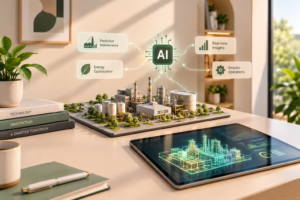
Artificial intelligence is driving a new wave of technological innovation that goes far beyond chatbots, content generation, and automated customer support. One particularly promising development is the combination of AI with digital twin technology. This combination is helping businesses create intelligent virtual representations of physical objects, buildings, machines, production facilities, and even complex urban environments.
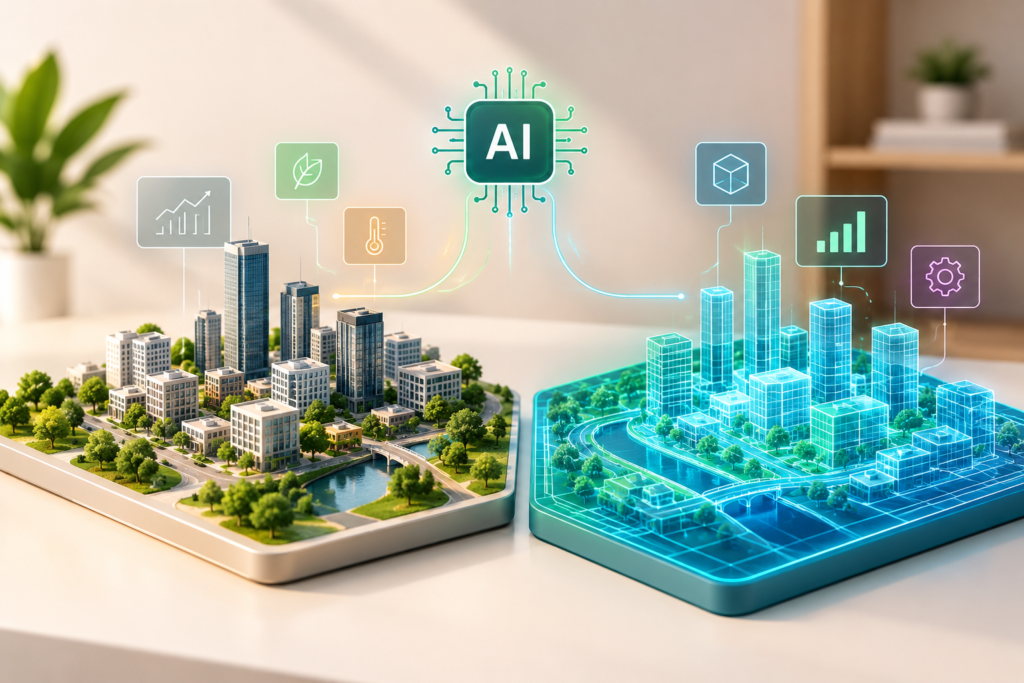
A digital twin is more than a three-dimensional model or a digital copy of a real-world object. It can use data from sensors, connected devices, operational systems, and other sources to represent the changing condition of its physical counterpart. When artificial intelligence is added, the digital twin can help identify patterns, estimate future performance, detect potential problems, and evaluate possible improvements.
For example, a manufacturing company could use an AI-powered digital twin to study how a production line behaves under different operating conditions. Instead of waiting for equipment to fail, engineers could examine warning signals, test alternative maintenance schedules, and investigate how changes might affect productivity.
Similar approaches are being explored in transportation, energy, construction, healthcare research, and smart-city planning.
The growing importance of this innovation comes from its ability to connect real-world operations with intelligent analysis. Rather than relying exclusively on historical reports or physical experiments, organizations can investigate scenarios in virtual environments before making expensive or complicated changes.
However, AI-powered digital twins also introduce challenges involving data quality, cybersecurity, implementation costs, and the reliability of computer-generated predictions.
Understanding how this technology works, where it can be applied, and what limitations it faces provides a useful perspective on the next generation of AI innovation.
What Is an AI-Powered Digital Twin?
A digital twin is a virtual representation of a physical asset, process, or system that can be updated using information from the real world.
Traditional digital models usually represent an object’s design or expected behavior. A digital twin can go further by incorporating changing operational data.
For instance, a digital twin of an industrial machine might receive information about temperature, vibration, operating speed, energy consumption, and maintenance history.
Artificial intelligence can analyze this information to identify unusual patterns and estimate how the machine may behave under different conditions.
The result is a system that can support monitoring, simulation, prediction, and decision-making.
An AI-powered digital twin typically combines several components:
Physical asset: The real-world machine, building, vehicle, production line, or infrastructure system being represented.
Data collection: Sensors, connected devices, business applications, and other sources provide information about the physical environment.
Virtual representation: Software models the relevant properties and behavior of the physical system.
Artificial intelligence: Machine learning and other AI techniques analyze data, identify patterns, and generate predictions or recommendations.
Feedback and control: Depending on the application, approved insights may inform operational decisions or support automated adjustments.
Not every digital twin includes all these capabilities. Some are designed primarily for monitoring, while others support complex simulations or carefully controlled automation.
The defining idea is that the virtual representation remains meaningfully connected to the real-world system and can help people understand how it behaves.
How AI and Digital Twin Technology Work Together
The combination of AI and digital twins creates opportunities that neither technology necessarily provides on its own.
Digital twins offer a structured representation of physical systems, while AI can help interpret large volumes of operational information.
Together, they can support a continuous process of observation, analysis, and improvement.
1. Collecting Real-Time Information
Many physical systems generate data continuously.
Industrial machines produce information about their operating conditions. Buildings record energy consumption and environmental measurements. Vehicles generate information about location, performance, and component health.
Connected sensors and operational systems can send this information to the digital twin.
The quality of the resulting insights depends on whether the information is accurate, timely, and relevant to the problem being investigated.
Missing readings, faulty sensors, or delayed updates can weaken the digital twin’s ability to represent reality.
2. Understanding Operational Patterns
Once data is available, AI models can examine it to identify relationships that may not be obvious from individual measurements.
For example, a machine’s temperature might normally fluctuate during operation. A single high reading may not indicate a serious problem.
However, an AI model could identify a combination of increasing temperature, unusual vibration, and changing energy consumption that has previously been associated with mechanical deterioration.
The digital twin can provide context about the machine’s operating conditions, helping engineers investigate whether the pattern requires attention.
Such findings are indicators for further analysis, not automatic proof that a failure will occur.
3. Simulating Different Scenarios
One of the most useful capabilities of digital twins is the ability to explore alternative scenarios.
Engineers can investigate how a system might respond to changes in operating speed, workload, environmental conditions, or maintenance schedules.
AI can help identify promising scenarios to test and analyze the resulting data.
For example, a logistics company could simulate alternative warehouse layouts to determine how they might affect travel distances, order processing, and equipment utilization.
The organization can compare possible approaches before implementing changes in the physical warehouse.
Simulation quality depends on how accurately the virtual model represents real-world behavior. A simulation should therefore be validated against actual measurements before its results are used for important decisions.
4. Supporting Better Decisions
The final step involves translating analysis into useful operational recommendations.
An AI-powered digital twin might help an engineer prioritize equipment inspections, help a building manager investigate excessive energy consumption, or help a transport planner compare alternative traffic-management strategies.
Human experts can evaluate these recommendations alongside operational requirements, safety standards, budgets, and other constraints.
In some applications, approved systems may automatically adjust selected operating parameters. However, high-risk changes require appropriate safeguards, monitoring, and opportunities for human intervention.
Major Applications of AI-Powered Digital Twins
AI-powered digital twins are relevant to numerous industries because many organizations need to understand complex physical systems and improve their performance.
1. Smart Manufacturing
Manufacturing is one of the most promising areas for digital twin applications.
Modern factories often contain interconnected machines, robotics systems, conveyor belts, inspection equipment, and production-management software.
A disruption in one area can affect the performance of the entire production line.
An AI-powered digital twin can help manufacturers monitor equipment conditions, evaluate production bottlenecks, and understand how changes in one process affect other operations.
For example, a factory producing electronic components could create digital twins of critical machines and monitor their operating data.
If the system identifies unusual vibration patterns or declining production performance, maintenance teams can investigate before the problem becomes a major disruption.
Manufacturers can also use simulations to compare production schedules, evaluate new equipment configurations, and investigate potential improvements.
The possible benefits include reduced unplanned downtime, better resource utilization, and more informed maintenance planning.
However, these benefits are not automatic. They depend on accurate models, reliable data, and effective integration with existing factory systems.
2. Smart Buildings and Energy Management
Buildings consume energy through lighting, heating, cooling, ventilation, elevators, and other systems.
Their energy requirements change according to occupancy, weather, equipment performance, and operating schedules.
A digital twin can represent these interconnected systems and provide a clearer picture of building performance.
AI can analyze energy-consumption patterns and identify conditions that may indicate unnecessary usage.
For example, an office building might continue cooling an area after most employees have left for the day. An AI system could identify this pattern and recommend adjustments to operating schedules.
A more advanced system might evaluate alternative temperature settings while considering comfort requirements and expected occupancy.
Digital twins can also support planning for building renovations by allowing engineers to examine potential changes before carrying out expensive construction work.
These applications can help facility managers improve energy efficiency, although the actual savings depend on the building’s design, climate, equipment, and operating practices.
3. Smart Cities and Urban Planning
Cities contain complicated networks of roads, public transportation, water systems, electricity infrastructure, buildings, and public services.
Changes in one part of the urban environment can influence many other areas.
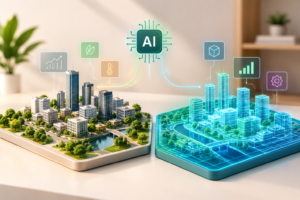
Digital twins can help city planners create virtual representations of selected urban systems and evaluate how they might respond to different conditions.
AI can analyze traffic patterns, infrastructure measurements, and other relevant information to support planning decisions.
For example, a city could model how a proposed road redesign might influence traffic movement at nearby intersections.
Planners could compare different layouts, examine likely congestion points, and consider the effects on public transportation.
Similar methods may help evaluate drainage infrastructure, energy demand, and emergency-response planning.
However, cities must consider privacy, data ownership, public accountability, and the risk of excluding communities that are poorly represented in available data.
Urban digital twins should support transparent planning rather than replace public consultation and democratic decision-making.
4. Transportation and Logistics
Transportation networks involve vehicles, warehouses, roads, distribution centers, and delivery schedules.
AI-powered digital twins can help organizations understand how these elements interact.
A logistics company might create a digital representation of its warehouse and distribution operations.
The system could analyze order volumes, vehicle availability, loading capacity, and delivery schedules to identify potential bottlenecks.
AI models could then help compare alternative delivery routes or warehouse arrangements.
For example, a business experiencing seasonal increases in online orders could simulate how different staffing levels and picking strategies might affect order-processing times.
Transport operators may also use digital twins to study vehicle performance and plan maintenance.
Nevertheless, route recommendations and operational forecasts should account for uncertainty. Unexpected weather, road closures, equipment failures, and changes in demand can make actual conditions different from simulated scenarios.
5. Healthcare Research and Medical Equipment
Healthcare-related digital twins are an evolving field with several distinct applications.
Hospitals and medical-device manufacturers may use digital representations of equipment, facilities, and clinical workflows to understand system performance and improve planning.
For example, a hospital could model patient movement through an emergency department to investigate waiting times and resource allocation.
A digital twin of medical equipment might help engineers study performance under different operating conditions.
Researchers are also investigating approaches that combine physiological models, patient information, and AI to support more individualized analysis.
However, a virtual representation of a person is not automatically an accurate or complete model of their health.
Individual physiology is complex, and predictions may be affected by incomplete data, uncertain assumptions, and differences between populations.
Applications intended to influence diagnosis or treatment require rigorous clinical validation, appropriate privacy protections, and professional oversight.
AI-powered digital twins should not be presented as replacements for qualified healthcare professionals.
The Role of Generative AI in Digital Twin Innovation
Generative AI is introducing new ways for people to interact with digital twins.
Traditional digital twin platforms can be technically complicated. Users may need specialized knowledge to navigate dashboards, interpret simulation results, or configure different scenarios.
Conversational AI could make these systems easier to use.
For example, an engineer might ask, “What changed in the machine’s performance during the last two weeks?”
A connected AI assistant could retrieve relevant information, summarize observed changes, and identify measurements that deserve further investigation.
A facility manager might ask which areas have experienced the largest increases in energy consumption.
The assistant could summarize available data and direct the manager toward relevant sections of the digital twin.
Generative AI may also help users create simulation scenarios by translating natural-language requests into structured instructions.
However, the assistant must distinguish between verified measurements, model predictions, and speculative explanations.
A language model could produce a convincing but incorrect description of an engineering problem if it lacks access to reliable information.
For this reason, effective systems should connect responses to underlying data, communicate uncertainty, and allow experts to verify important findings.
Generative AI can make digital twins easier to use, but it does not eliminate the need for accurate simulations or engineering knowledge.
Benefits of AI-Powered Digital Twins
Organizations may gain several advantages from combining AI with digital twin technology.
Predictive Maintenance
Traditional maintenance schedules often rely on fixed intervals or inspections conducted after a problem becomes noticeable.
AI-supported digital twins can help teams identify patterns associated with changing equipment conditions.
This may allow maintenance to be planned more effectively and reduce unnecessary inspections.
However, predictive maintenance is most effective when the models are validated and maintenance decisions account for equipment criticality and safety requirements.
Lower Operational Costs
Digital twins can help organizations evaluate potential improvements before implementing them in the real world.
A factory may investigate production schedules, while a building manager may compare energy-management strategies.
By identifying promising changes in advance, organizations can reduce the cost of trial and error.
The financial outcome depends on implementation costs, model accuracy, and whether the recommended improvements work under actual operating conditions.
Improved Product Design
Manufacturers can use digital twins to examine product behavior during different stages of development.
Engineers may evaluate design alternatives, investigate potential weaknesses, and explore how materials or operating conditions influence performance.
AI can assist by analyzing test results and identifying combinations worth investigating.
These methods may reduce the number of physical experiments required for some tasks, although real-world testing remains important for validating safety and performance.
Better Resource Utilization
AI-powered simulations can help organizations understand how equipment, labor, energy, and materials are being used.
For example, a distribution center might discover that certain storage arrangements increase travel time unnecessarily.
By testing alternative configurations virtually, managers can compare options before rearranging the physical facility.
More Informed Risk Management
Digital twins can help organizations investigate how systems might respond to disruptions.
A power utility, for example, could model different demand conditions or equipment outages to support contingency planning.
The resulting scenarios can help engineers identify vulnerabilities and prepare appropriate responses.
Simulations cannot predict every possible event, but they can improve preparedness when combined with expert judgment and realistic assumptions.
Challenges and Limitations of This Technology
Despite its potential, AI-powered digital twin technology is not suitable for every organization or problem.
High Implementation Costs
Building a useful digital twin may require sensors, data infrastructure, modeling software, specialized expertise, and integration with existing systems.
Complex facilities can be especially expensive to represent accurately.
Organizations should begin with a clearly defined operational problem and assess whether the expected benefits justify the investment.
Data Quality Problems
AI models are only as useful as the information and assumptions supporting them.
Missing sensor readings, outdated equipment records, inconsistent measurement formats, and inaccurate timestamps can weaken a digital twin.
Businesses need reliable data-management processes and ongoing checks to ensure that virtual models remain aligned with physical systems.
Cybersecurity Risks
Connected digital twins may depend on operational data and interfaces linked to important infrastructure.
If attackers gain unauthorized access, they could expose sensitive information, disrupt operations, or manipulate the data used to generate recommendations.
Organizations should apply strong access controls, network segmentation, secure software updates, monitoring, and appropriate incident-response procedures.
Systems that can influence physical equipment require particularly careful protection.
Model Accuracy and Uncertainty
A digital twin is an approximation of reality, not reality itself.
Its accuracy depends on the assumptions, measurements, and modeling methods used to construct it.
An AI model trained under normal operating conditions may perform poorly during unusual events or unfamiliar environments.
Organizations should test models against real-world observations, document their limitations, and avoid relying on unsupported predictions.
Shortage of Specialized Skills
Successful implementation may require expertise in engineering, data science, simulation, cybersecurity, and operational management.
Companies without these capabilities may struggle to develop and maintain effective systems.
Training existing employees and introducing the technology gradually can help address this challenge.
How Businesses Can Start Using AI Digital Twins
Organizations interested in digital twins should adopt a practical, step-by-step approach.
Step 1: Identify a specific business problem.
Choose an issue that can be measured, such as frequent equipment downtime, excessive energy consumption, or production delays.
Step 2: Determine the available data.
Review whether the organization already collects useful operational information and identify gaps that need to be addressed.
Step 3: Build a limited digital model.
Start with one machine, production process, building system, or logistics operation instead of attempting to model the entire organization immediately.
Step 4: Add appropriate AI capabilities.
Introduce machine learning or predictive analytics only where they provide a clear advantage over simpler monitoring and simulation techniques.
Step 5: Validate the results.
Compare the virtual model’s behavior with actual observations and investigate significant differences.
Step 6: Measure business outcomes.
Track relevant indicators, such as maintenance costs, energy consumption, equipment availability, or production efficiency.
Step 7: Expand carefully.
If the pilot delivers measurable benefits, consider extending the approach to additional assets or processes.
This gradual strategy helps organizations learn from practical experience while controlling costs and implementation risks.
The Future of AI-Powered Digital Twins
The future of digital twins will likely involve closer connections between AI, robotics, the Internet of Things, simulation technologies, and industrial automation.
As sensors become more capable and computing infrastructure improves, organizations may be able to create more detailed representations of complex physical systems.
AI could help these systems adapt to changing operating conditions, investigate unusual events, and suggest improvements more quickly.
In manufacturing, this may support increasingly flexible production environments. In buildings, it could improve coordination between energy systems and occupancy requirements. In transportation, digital twins may help planners evaluate complex changes before implementing them.
Another potential development is the use of AI agents to coordinate selected tasks within digital twin environments.
For example, an AI agent might monitor equipment performance, prepare a maintenance recommendation, check whether the necessary replacement parts are available, and present a proposed schedule for approval.
Such workflows could connect analysis with practical action, provided the agent has appropriate permissions and its recommendations are subject to suitable controls.
Advances in simulation may also help organizations investigate situations that are difficult, dangerous, or expensive to reproduce physically.
Nevertheless, the future will not depend solely on making virtual models more detailed. It will also depend on improving reliability, interoperability, security, and explainability.
Organizations will need to understand not just what an AI system recommends, but also which evidence supports that recommendation and where uncertainty remains.
Conclusion
AI-powered digital twins represent an important direction in technological innovation because they connect virtual modeling with intelligent analysis of real-world systems.
By combining operational data, simulation, and artificial intelligence, organizations can investigate equipment performance, improve maintenance planning, explore alternative designs, and make more informed decisions.
The technology has potential applications across manufacturing, transportation, smart buildings, urban planning, and healthcare research.
However, successful implementation requires more than advanced algorithms. Accurate data, reliable models, cybersecurity, skilled professionals, and realistic performance evaluations are essential.
Businesses should begin with focused applications, validate results carefully, and expand only when measurable benefits justify the investment.
Ultimately, AI-powered digital twins offer a way to understand complex systems before making important real-world changes. Their greatest value lies in helping people test possibilities, anticipate problems, and make better decisions while maintaining human oversight and responsible control.