AI-Powered Digital Twins: The Next Big Innovation Transforming Industries
Introduction
Artificial intelligence (AI) is transforming the way businesses design products, manage operations, solve problems, and make decisions. Among the most promising developments in this field is the emergence of AI-powered digital twins. This innovative technology combines artificial intelligence, real-time data, simulation, and predictive analytics to create intelligent virtual representations of physical objects, systems, and processes.
Unlike traditional computer models, AI-powered digital twins can continuously learn from incoming information, identify patterns, predict potential problems, and help organizations explore different outcomes before making real-world decisions. From manufacturing facilities and smart cities to healthcare systems and energy networks, this technology is creating new opportunities for efficiency, accuracy, and innovation.
As organizations increasingly adopt intelligent automation, digital twins are becoming an important tool for understanding complex environments and preparing for future challenges. This article explores how AI-powered digital twins work, their major applications, benefits, challenges, and potential role in shaping the future of technology.
What Are AI-Powered Digital Twins?
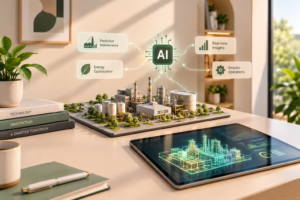
A digital twin is a virtual representation of a real-world object, system, or process. It uses data collected from physical sources to reflect the condition, performance, and behavior of its real-world counterpart.
For example, a manufacturing company might create a digital twin of a production machine. Sensors installed on the machine collect information about temperature, vibration, speed, energy consumption, and operating conditions. This information is transferred to the digital model, allowing engineers to monitor the machine’s performance without constantly inspecting it physically.
Artificial intelligence makes this process significantly more powerful. AI algorithms analyze the collected information, identify unusual patterns, estimate future performance, and recommend possible improvements.
A conventional digital model might show how a machine is currently operating. An AI-powered digital twin can go further by predicting when the machine may fail, identifying the likely cause, and helping engineers evaluate different maintenance strategies.
The technology combines several important components, including connected sensors, cloud computing, data analytics, machine learning, simulation software, and visualization tools. Together, these technologies create a system that supports continuous monitoring, prediction, and decision-making.
How AI-Powered Digital Twins Work
AI-powered digital twins operate through a continuous cycle of data collection, analysis, simulation, and improvement.
1. Collecting Real-Time Data
The process begins with gathering information from a physical object or environment. Sensors, connected devices, industrial machines, cameras, and software systems can provide data about operating conditions and performance.
For example, sensors in a commercial building might measure room temperature, air quality, electricity consumption, and the number of people occupying different spaces.
The quality of this information is important because inaccurate, incomplete, or delayed data can reduce the reliability of the digital twin.
2. Creating a Virtual Representation
The collected data is used to build a digital representation of the physical system. Depending on the application, this representation may include a three-dimensional model, a mathematical simulation, a network diagram, or a detailed software-based model.
The digital twin is designed to reflect relevant characteristics of the real-world system.
A digital twin of an aircraft engine, for example, may represent its major components, operating limits, temperature patterns, fuel consumption, and mechanical behavior.
3. Applying Artificial Intelligence
Machine learning models analyze historical and current data to discover patterns that may not be obvious through ordinary monitoring.
AI can recognize relationships between operating conditions and performance outcomes. It can also identify unusual behavior that may indicate equipment damage, operational inefficiencies, or emerging risks.
The system becomes more useful when its predictions are evaluated against actual results and its models are updated appropriately.
4. Running Simulations
One of the most valuable features of a digital twin is the ability to test possible scenarios in a virtual environment.
Engineers can examine what might happen if a machine operates at a higher temperature, if production demand increases, or if a component is replaced with a different design.
These simulations help organizations compare alternatives before implementing expensive or potentially disruptive changes in the real world.
5. Supporting Better Decisions
After analyzing the information, the digital twin can provide recommendations, alerts, forecasts, or proposed operational adjustments.
Depending on the system, authorized operators may implement these recommendations manually, or certain low-risk actions may be automated.
For safety-critical applications, human supervision and independent validation remain essential.
Major Applications of AI-Powered Digital Twins
1. Manufacturing and Industrial Automation
Manufacturing is one of the most promising areas for AI-powered digital twin technology.
Factories depend on complex equipment, coordinated production lines, and carefully managed supply chains. Unexpected equipment failures or production delays can lead to substantial financial losses.
AI-powered digital twins allow manufacturers to monitor equipment conditions, simulate production processes, and identify potential bottlenecks.
For example, a factory can create digital twins of its assembly lines to understand how changes in production speed affect the entire operation. AI models can analyze historical performance and suggest ways to improve equipment utilization.
Predictive maintenance is another important application. Rather than servicing machinery only according to a fixed schedule, companies can use operational data to identify signs of deterioration and plan maintenance more effectively.
This approach can help reduce unexpected downtime, improve product consistency, and support better resource allocation.
2. Healthcare and Medical Innovation
Healthcare organizations are exploring digital twins to improve equipment management, hospital operations, treatment planning, and medical research.
A hospital could create a digital twin of its facilities to understand patient movement, bed availability, staffing requirements, and equipment utilization. AI could analyze this information to help administrators identify delays and distribute resources more effectively.
In medical research, digital models can support the study of biological processes and help researchers investigate how different conditions influence potential outcomes.
The concept of a patient-specific digital twin is particularly interesting. Researchers are investigating how information such as medical imaging, clinical measurements, and patient history might contribute to individualized computational models.
However, a complete and reliable digital replica of an individual human body remains an ambitious research goal rather than a routine clinical capability.
Any healthcare application must account for patient privacy, data quality, clinical validation, and medical oversight. AI-generated predictions should not replace professional medical judgment.
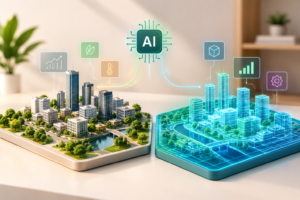
3. Smart Cities and Urban Planning
Cities contain interconnected systems involving roads, public transportation, electricity, water distribution, buildings, and waste management.
AI-powered digital twins can help urban planners understand how these systems interact and evaluate the consequences of proposed changes.
For example, a city could create a digital model of a busy transportation network. AI algorithms could analyze traffic patterns, road closures, public transit schedules, and historical congestion data to identify potential improvements.
Planners could simulate different traffic signal timings or evaluate how a new road might influence surrounding neighborhoods.
Digital twins can also support energy management, infrastructure maintenance, flood-risk planning, and environmental monitoring.
By testing possible solutions virtually, city authorities may be able to identify weaknesses earlier and make more informed investment decisions.
Nevertheless, the accuracy of these systems depends on reliable data, appropriate assumptions, and regular updates as urban conditions change.
4. Energy and Renewable Power
The energy sector is another area where AI-powered digital twins offer considerable potential.
Power plants, electricity grids, wind turbines, solar installations, and energy storage facilities generate large amounts of operational data.
Digital twins can use this information to monitor performance, identify inefficiencies, and estimate maintenance requirements.
In a wind farm, for instance, an AI-powered digital twin could analyze turbine vibration, wind speed, temperature, and power output to identify unusual behavior.
The model could help maintenance teams investigate possible equipment problems before they cause extended downtime.
For renewable energy systems, digital twins can also help operators examine how weather conditions, equipment performance, and electricity demand affect power generation.
At the grid level, digital models can support planning for changing electricity consumption and the integration of variable renewable sources.
These applications may improve operational planning, although actual results depend on implementation quality and the characteristics of the energy infrastructure.
5. Automotive and Aerospace Engineering
Automotive and aerospace companies use sophisticated simulations to design products, evaluate performance, and improve safety.
AI-powered digital twins extend these capabilities by combining engineering models with information from testing, production, and real-world operation.
Automotive manufacturers can use digital twins to examine vehicle components, monitor manufacturing quality, and investigate how different operating conditions affect performance.
For electric vehicles, digital models may help engineers analyze battery temperature, charging behavior, energy consumption, and long-term degradation.
In aerospace, digital twins can support aircraft component monitoring, engine performance analysis, maintenance planning, and design evaluation.
These models allow engineers to investigate complex scenarios without repeatedly conducting expensive physical tests.
However, virtual simulations must be validated against physical measurements and established engineering standards before they can support critical safety decisions.
6. Retail and Supply Chain Management
Retail businesses must balance customer demand, product availability, inventory costs, transportation, and warehouse operations.
AI-powered digital twins can provide a virtual representation of these interconnected activities.
A retailer could model a warehouse to evaluate how changes in product placement affect picking times and order processing. AI algorithms could analyze order patterns and identify potential inventory shortages.
Supply chain digital twins can also help organizations simulate the effects of shipping delays, supplier disruptions, or sudden increases in demand.
For example, a business could compare alternative distribution routes and inventory strategies before changing its logistics operations.
This capability is particularly valuable when companies operate across multiple regions and depend on several suppliers.
Although digital twins cannot eliminate supply chain uncertainty, they can help businesses explore alternatives and prepare contingency plans.
Key Benefits of AI-Powered Digital Twins
Improved Predictive Maintenance
One of the most important advantages is the ability to identify possible equipment failures before they occur.
By analyzing sensor readings and historical maintenance records, AI models can recognize patterns associated with deterioration.
Maintenance teams can use these predictions to prioritize inspections, schedule repairs, and reduce avoidable interruptions.
Better Decision-Making
Digital twins provide a controlled environment for testing different decisions.
Businesses can compare operational strategies, investigate potential risks, and estimate likely consequences before implementing changes.
This can make planning more systematic, particularly when decisions involve expensive equipment or interconnected processes.
Reduced Operational Costs
Equipment failures, inefficient energy consumption, production delays, and poorly planned maintenance can increase business expenses.
Digital twins may help reduce these costs by identifying inefficiencies and supporting better resource allocation.
However, organizations must compare the expected savings with the costs of developing, integrating, and maintaining the technology.
Faster Product Development
Engineers can use virtual models to evaluate designs, simulate operating conditions, and identify weaknesses earlier in the development process.
This may reduce the number of physical prototypes required and help teams investigate more design alternatives.
Physical testing remains important, especially when products must meet strict safety and performance standards.
Greater Operational Visibility
Digital twins can bring information from multiple systems into a unified view.
Instead of examining disconnected reports, operators can understand how different parts of a system influence one another.
This broader perspective can help identify the underlying causes of problems rather than addressing only their visible symptoms.
Support for Sustainability
Digital twins can help organizations monitor energy use, water consumption, material waste, and equipment efficiency.
AI models can evaluate alternative operating strategies to determine which options may reduce resource consumption.
For example, a building operator could simulate different heating and cooling schedules to explore opportunities for improving energy efficiency while maintaining comfortable indoor conditions.
The environmental benefits depend on actual implementation and should be measured using real operational data.
Challenges and Limitations of AI-Powered Digital Twins
Despite their potential, AI-powered digital twins face several important challenges.
High Initial Investment
Building a reliable digital twin may require sensors, computing infrastructure, specialized software, data integration, engineering expertise, and ongoing maintenance.
Smaller businesses may find these costs difficult to justify, especially when the expected benefits are uncertain.
Starting with a limited pilot project can help organizations evaluate the technology before making a larger investment.
Data Quality and Integration
Digital twins depend on accurate and timely information.
If sensors produce faulty measurements or different systems use incompatible data formats, the virtual model may not accurately represent the physical environment.
Organizations need effective data governance, validation procedures, and integration strategies to maintain reliability.
Cybersecurity and Privacy
Connected digital twins can contain sensitive operational information, business records, infrastructure details, or personal data.
Unauthorized access could expose confidential information or create opportunities for malicious interference.
Companies should implement access controls, encryption, network monitoring, secure software updates, and appropriate data-retention policies.
Healthcare and other privacy-sensitive applications require additional safeguards.
Model Accuracy and Reliability
AI predictions are not always correct. Models can perform poorly when operating conditions change or when they encounter situations that were not adequately represented in their training data.
A digital twin may also produce misleading results if its underlying physical assumptions are incorrect.
Regular validation, uncertainty assessment, and human oversight are essential for maintaining trustworthy results.
Shortage of Specialized Skills
Developing effective digital twins requires expertise in several fields, including AI, software engineering, data analysis, simulation, and domain-specific operations.
Organizations may struggle to find professionals who understand both the technical systems and the practical environments in which they operate.
Training existing employees and building cross-functional teams can help address this challenge.
The Role of Generative AI in Digital Twins
Generative AI is creating additional possibilities for digital twin technology.
Traditional digital twins often depend on dashboards, predefined reports, technical visualizations, and specialized simulation tools. Generative AI can provide a more conversational way to interact with these systems.
For example, an engineer could ask a digital twin, “Why has this machine’s energy consumption increased during the last week?”
A connected AI assistant might examine available sensor readings, compare recent performance with historical patterns, and summarize possible explanations.
A manager could ask the system to compare two production schedules or explain the likely operational effects of increasing output.
Generative AI may also help users write simulation scripts, summarize technical documentation, and explore alternative scenarios.
However, a language model should not be treated as a source of unquestionable engineering truth. Its explanations and recommendations must be grounded in reliable data and validated against appropriate technical models.
Combining generative AI with established simulation systems may make digital twins easier to use, particularly for employees who do not have advanced programming skills.
How Businesses Can Adopt AI-Powered Digital Twins
Organizations interested in this technology should begin with a clearly defined business problem.
The first step is to identify an area where better monitoring, forecasting, or simulation could provide measurable value. Examples include reducing equipment downtime, improving warehouse efficiency, or lowering energy consumption.
Next, the organization should determine whether suitable data is available and whether existing systems can provide the necessary information.
A small pilot project is often a sensible starting point. Instead of modeling an entire factory or supply chain, a business might create a digital twin for one machine, production line, or warehouse process.
The organization can then establish performance indicators, such as equipment downtime, maintenance expenses, processing time, or energy consumption.
Results should be compared with a reliable baseline to determine whether the project delivers meaningful improvements.
Businesses should also consider cybersecurity, employee training, integration costs, model maintenance, and operational responsibilities from the beginning.
Once the pilot demonstrates value, the organization can gradually expand the system to other processes.
This measured approach reduces unnecessary complexity and helps ensure that investment decisions are based on practical evidence rather than technological enthusiasm alone.
The Future of AI-Powered Digital Twins
The future of digital twins will likely involve greater integration with connected sensors, robotics, edge computing, advanced simulation, and generative AI.
As these technologies develop, digital twins may become more responsive and capable of analyzing increasingly complex systems.
Edge computing could allow certain analyses to take place close to the physical equipment, reducing delays when rapid responses are required.
Advances in machine learning may improve the ability to detect unusual behavior, forecast performance, and adapt models to changing conditions.
Robotics could also benefit from digital twins by allowing developers to test movements, evaluate operating environments, and refine control strategies in simulation before deploying physical machines.
Another important development will be the creation of interconnected digital twins. Rather than modeling a single machine or building, organizations may connect multiple models to examine how entire systems behave together.
For example, connected models of buildings, transportation networks, and electricity infrastructure could help planners understand the relationships between urban development, mobility, and energy demand.
However, broader adoption will require better interoperability, dependable data standards, stronger security, and clearer approaches to validating AI-generated predictions.
The most successful implementations will probably be those that combine advanced technology with realistic goals, sound engineering, and effective human supervision.
Conclusion
AI-powered digital twins represent an important innovation in the growing relationship between artificial intelligence and the physical world. By combining real-time data, virtual modeling, predictive analytics, and simulation, they help organizations understand complex systems and evaluate decisions before implementing them in reality.
Their applications extend across manufacturing, healthcare, smart cities, renewable energy, automotive engineering, aerospace, and supply chain management. Potential benefits include improved maintenance planning, more efficient operations, better visibility, and more informed decision-making.
Nevertheless, digital twins are not a universal solution. High implementation costs, unreliable data, cybersecurity concerns, and limitations in AI predictions must be addressed carefully.
As AI and simulation technologies continue to advance, digital twins could become increasingly valuable tools for businesses, engineers, researchers, and public institutions.
The real opportunity lies not simply in creating virtual copies of physical systems, but in using intelligent models to solve meaningful problems, reduce uncertainty, and make better decisions in an increasingly connected world.